A review by Trichelle Lee [2020]
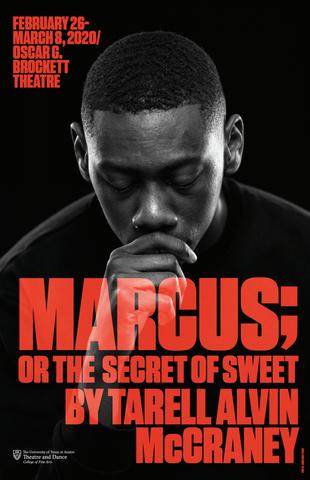
Welcome, here I will review and analyze the last play in Tarell McCraney’s Brothers/Sisters Plays trilogy, Marcus; or the Secret of Sweet (Marcus;). I saw the play about 2 weeks ago at the UT Oscar G. Brockett Theater and I loved it so much I decided to review it! If McCraney’s name doesn’t ring a bell his screenplay, In Moonlight Black Boys Look Blue, is responsible for the 2017 Academy Award winner for Best Picture, Moonlight (2017). Marcus; is something McCraney whipped up while in the playwriting program at Yale’s School of Drama. The San Pere, Louisiana drama has some intertextualities with the film Moonlight but completely stands on its own as an original body of work. This final installation of what McCraney considers a “triptych” is heavily inspired by Yoruba mythology and Black life and identity in the South— specifically the Louisiana projects. Despite Moonlight being set in Liberty City, Miami, the bells of dreams, bastardhood, poverty, crime, and single-motherhood still ring. Last but not least, they are both coming-of-age tales of adolescent Black men exploring not just their sexuality but their identity as a whole. I absolutely enjoyed the honor of watching Marcus; but this review will be my honest opinion and the Play will not be spared from criticism.
First and foremost, Marcus; is in a class of its own when it comes to creativity and originality. McCraney created an exceptional body of work and his gift cannot be overlooked. Set in the San Pere, Louisiana projects, protagonist Marcus Eshu, is 16 and “sweet.” “Sweet” is a slang term for “gay” that is frequently used in the Black community, especially in the South. To be clear, it is not offensive or derogatory like the “F” word but being deemed “sweet” isn’t necessarily “sweet.” Like it’s more colloquial brothers, “gay” and “homosexual” it comes with its own load of baggage and unsavory connotations. At the beginning of the play, Marcus’s good friend Shaunta takes a stab at the origins of the word by stating during Slavery plantation masters would punish homosexual activity between slaves by rubbing sugar into their lash wounds and letting the sun turn their blood into red syrup—therefore turning the slaves “sweet.” Shaunta goes onto mention how this punishment wasn’t necessarily for being gay but that it was an economic issue. If slaves were gay they wouldn’t reproduce and therefore the money machine would come to a halt.

Like Chiron in Moonlight,Marcus’s queer nature is what leads people to believe he may be “sweet.” The young man has friends but he also has dreams and in compliance with the title of the Play, secrets. He is repeatedly asked by his best friends Shaunta and Osha about the status of his sexuality but, at the beginning it seems as if he truly isn’t sure about where his desires lie. In fact the Play opens inside this very dream that gets this the action going. In the dream Marcus is visited by a strange man, who we later find out is Oshoosi as the dream reoccurs throughout the Play.
Oshoosi is desperately trying to deliver an important message to Marcus but the heavy rain makes it difficult for him to understand. The perplexed teen turns to his community for meaning and embarks upon a journey that leaves yearning to find out more about his deceased father, Elegba, to put the puzzle together. However, his Mother, Oba and other adults in the community are reluctant to disclose much about his father and always find themselves “busy” anytime Marcus brings the matter up. The audience is given clues that Elegba may have been “sweet” as well but the San Pere community’s silence on the matter speaks to how homosexuality is ignored and “buried” (pun intended) in the Black community rather than talked about. Upon speaking to his elder, Elegua about his dream she tells him that his Father would have dreams as well; some that even came true. If Ogun hadn’t stepped in and interrupted the two Elegua would have more than likely given Marcus more important information.
That evening Marcus follows his dream to the Bayou and runs into Ogun. Ogun happens to be Oshoosi’s brother and their conversation is where Marcus begins to receive any kind of answers or clarity. While Ogun isn’t as involved nor as essential to the development of Marcus as Juan was to Chiron in Moonlight, he still acts as sort of a father figure to the Youth. It is hinted at earlier in the Production that Marcus’s father had a close relationship with Oshoosi. Ogun tells Marcus that Oshoosi and Elegba ran into issues with the law that resulted in Oshoosi running away and Elegba turning himself in and dying in prison. At the end of their chat the two share a kiss and are caught by classmate, Terell and best friends Shaunta and Osha. With his closet door finally open, bestie Shaunta is upset that Marcus hadn’t told her about his newfound sexuality (remember she asked him about his sexuality orientation earlier?). On the other hand, bestie Osha is upset because she was hoping that one day she could be Mrs. Eshu. Feeling pretty bitter about the situation the ladies leave the scene.
It’s not long after that Marcus finds himself in the company of Shua, who portrays the classic “gangster” archetype all too well.The classic “thug” archetype, Shua’s getup consist of, a white wife-beater, baggy sagging jeans (that tell tales of their own), a du rag (looks at Chiron and Juan from Moonlight), and a walk with an intentional limp. This outfit is all a part of the costume that the Bronx native puts on everyday in an attempt to convince society that he’s straight. This is an extremely similar costume to the one that Chiron put on everyday once he became Black in the film’s third act. Later that day, the two men meet and Marcus performs oral sex on Shua. Sure that he is truly gay now but ashamed of what he’s done, he confesses to Shaunta.
It isn’t until after these two have an “encounter” is the audience or Marcus aware that he is currently seeing Marcus’s best friend Osha. Once again this scenario brings back memories of the “DL” behavior taking place in Moonlight. Virtually no-one in the film suspects Kevin of being gay because not only does he put on an act everyday that he’s the stereotypical heterosexual Black man but is so committed to his getup that he uses a woman, particularly a Black woman, as the final accessory to compliment said getup. While Shua hasn’t extended his collection of accessories to a child as Kevin had, he is surely using Osha in his ploy to convince the small world that is the San Pere projects, that he is “straight.” Carrying on with the intertextualities, Shua rejects Marcus just as Kevin had willingly publicly assaulted Chiron in an effort to keep the act up. However, Shua is eventually exposed and is forced to retreat.
The heavy rain that Marcus kept seeing in his dream has fully manifested into a physical storm. Finally able to interpret the message that Oshoosi was trying to deliver to Ogun all along, Marcus tells him, “the sky is bout / To open up, and God’s gone open his eye wide / Over the Bayou and the sky will cry.” Now sure that his brother is dead, Ogun walks off in a funeral procession as Marcus watches on to make sure he returns home safe.
Overall I thoroughly enjoyed watching Marcus; and look forward to watching another play from McCraney. The incorporation of African mythology with everyday African American life was ingenious and is a great way to deliver the message that despite our conditions here in physical form we as Black people are still Gods and Goddesses. McCraney always keeps it realistic when it comes to his depiction of young gay men exploring their sexuality and has no problem discussing the harsh truths that come with adolescence. The actors did a great job at bringing McCraney’s words to life and evoking plenty of laughter and emotion out of the crowd. Something I feel the need to point out is how Trevante Rhodes, the actor who played Black in Moonlight’s third act went to UT Austin! Hopefully some of these talents individuals will go on to work with and win many awards alongside Mccraney in the future. Bravo to McCraney and everyone apart of his production.
 Trichelle Works